I didn’t publish anything in July.
No launch day. No new headline. Nothing pushed into anyone’s feed.
Here’s what happened anyway:
- 536 presentations
- 501 views
- 159 reads
- 5 new followers
- 3 new subscribers
“Presentations” is Medium’s word for the number of times it put a piece of mine in front of someone.
Small numbers. I know. I’m not going to sit here and pretend 501 views is a movement.
The bit worth sitting with is the ratio. 159 reads out of 501 views is 32%. A third of the people who clicked stayed to the end, on work I wrote months ago, with nothing driving them there.
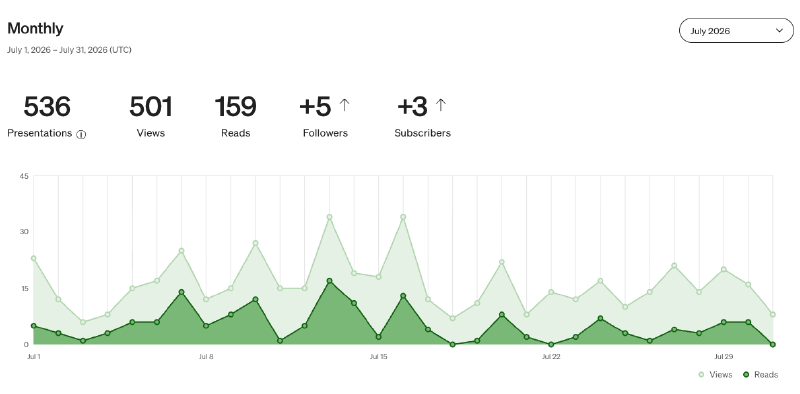
No launch spike, because there was nothing to launch. The two busiest days sit in the middle of the month and I’ve no idea what caused them. Views didn’t hit zero once in 31 days.
Nobody was pushing. People kept arriving.
That’s made me rethink what I’ve been calling consistency.
The treadmill#
Most advice about writing online collapses consistency into frequency.
Publish weekly. Feed the algorithm. Stay visible. Don’t lose momentum.
Fine as a discipline. It builds the habit, and the habit does matter.
But it quietly swaps the goal. Publishing becomes the objective, rather than the thing that happens when you’ve actually got something to say.
You start asking “what can I get out this week?”
I’ve been diagnosing that exact failure mode in delivery teams for years. Took me until July to notice I was running it on myself.
I’ve written this post before, about somebody else#
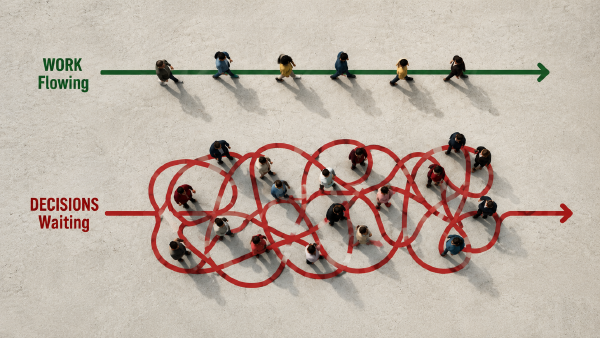
In June 2025, I published “The Feature Factory Strikes Back: How Output Masquerades as Progress.” Two weeks later, “You’re Not Outcome-Driven. You’re Output-Justified.”
The argument in both is that teams that measure themselves by what they ship stop asking whether shipping changed anything. The backlog becomes the goal. Plenty ships. Nothing changes for the people it was meant to help.
A weekly publishing schedule is the same machine with a different label on the side.
Posts are the features. The content calendar is the roadmap. And “what can I publish this week?” is “what can we get into this timebox?” wearing a writer’s hat.
I built a whole consulting practice on spotting this in other people’s systems and then ran it on my own writing without blinking.
What the archive actually says#
Two numbers from my lifetime stats that took me a while to accept.
“Smart Product Teams Keep Their Options Open” went out in February 2025. Medium put it in front of people 9,500 times. It got 947 views.
“A Roadmap is a Contract for Failure” went out in September 2025. Medium put it in front of people 411 times. It got 681 views and 263 reads.
23 times the distribution bought 39% more readers.
And look at the roadmap piece more closely: 681 views off 411 presentations. More views than presentations means most of the people who read it never saw it on Medium at all. They found it through a search, a share, a link someone dropped in a Slack channel. Same story with “The Visibility Trap” (452 presentations, 571 views) and “Everything I Got Wrong About Product” (617 presentations, 669 views, 345 reads).
Those are the posts doing the quiet work. They keep turning up in front of people through routes I don’t control and can’t see, long after I’ve forgotten I wrote them.
So what do they have in common?
None of them are about anything that happened that week.
Roadmaps as contracts. Say-Do as a dead end. Output dressed up as outcome. Forecasts treated as promises. Efficiency chosen over learning.
These problems come back every quarter, in every org, under whatever name is fashionable this year. The vocabulary rotates. The dysfunction sits still.
A post tied to a news cycle dies with the cycle. A post tied to a recurring problem gets years.
The bit that stings#
Here’s the part I’d rather have left out.
My 2026 work is underperforming my 2025 work. “Grading OKRs is just resulting with better branding” has 240 presentations and 17 views. “Some rituals are scaffolding. Some are anaesthetic.” has 286 and 51. Against that, “The Dirty Secret Behind Agile Failure” from April 2025 sits at 914 presentations, 648 views, 370 reads.
Some of that gap is just time. A post from early 2025 has had 18 months to find people. One from June has had 8 weeks. Compounding needs a runway, and lifetime stats are rigged in favour of whatever’s been alive longest.
But that only explains so much. “AI Won’t Fix Your Broken Delivery System” went out in February 2026, and it’s already on 613 views and 242 reads. 6 months old and ahead of nearly everything I published in 2024.
So the runway argument gets me part of the way and then leaves me standing there. Some of my recent stuff simply hasn’t landed, and the back catalogue has been carrying me while I work out why.
That’s an uncomfortable thing to publish. It’s also the most useful thing in this piece.
A launch tells you almost nothing#
If distribution is that uneven, a single post’s opening week is a rubbish signal.
A flat launch doesn’t mean the idea was wrong. A spike doesn’t mean the work will last.
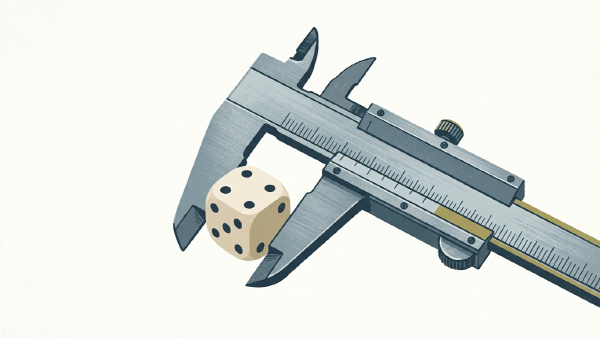
My most widely distributed piece is the dice one, “I Asked a Room Full of Leaders to Predict the Future, With Dice.” Medium showed it 17,100 times, and it converted 2,000 views. “Say-Do is a Dead End” got shown 6,800 times. It converted 2,900 views and 1,500 reads. It reached under half as many people, and 500 more of them read it to the end.
So the question I’ve started asking about a new piece isn’t how it opened. It’s what it’s doing in year 2. Does it still find people, and does it pull anyone through to something else I’ve written?
Those 3 subscribers in July matter more to me than a good launch week. Subscribing is a tiny act, but it’s deliberate. Nobody subscribes by accident.
What consistency actually buys you#
I still think consistency matters. I’m just no longer convinced it should be measured in posts per month.
There’s consistency in the problems you keep coming back to. Consistency in how hard you’re willing to think before you hit publish. Consistency in returning to an old argument once your view has moved on.
A weekly schedule can carry all of that. It can also carry none of it.
You can publish 50 times a year and end up with 50 unconnected posts. You can publish 12 and end up with a body of work.
The difference is whether you’re keeping a schedule or building a practice.
What I’m doing about it#
I’m not going to stop publishing regularly. July has changed what I think publishing is for.
Every new piece should make the ones around it easier to find. That means writing about problems with a long half-life. Linking arguments together instead of treating each post as a standalone event. Going back and revising when I’ve changed my mind. And not shipping something just because it’s Thursday.
If you write anything at all, go and pull your own numbers. Not this month’s. Sort your archive by reads and look at the publish dates.
If your top 5 are all from the last 8 weeks, you’re on the treadmill. If they’re spread across 2 years, you’ve got a system, and the useful work is figuring out what those 5 have in common.
Then do exactly the same thing with your backlog. Sort by shipped date and ask which features are still earning their keep.
I added nothing to my archive in July. 501 people turned up anyway.