When I joined a large multinational a few years back, one of the first things I asked for was access to their analytics. I wanted to do a basic audit of how people used the site, so I’d have something to bring to the team’s product review the following week.
In that review, 3 engineers demoed features they’d released the month before to “solve user problems”. The UX looked good - the features had been tested with real users long before release. Against how the team had defined the user need, the work was complete.
So I asked: “And how have users interacted with the features you released? I’d love to hear some real user feedback, now that these are in the wild?”
I already knew the answer, because I’d looked - the features weren’t instrumented; no one was measuring activation, usage or adoption, and there was no feedback. What the analytics did show was 30 visitors that month to the page those features sat on, and a bounce rate of 96.7%.
That’s slop. Finished by every definition the team had, released, and sitting unused. And it had nothing to do with AI, which is why I don’t quite buy the “product slop” story doing the rounds at the moment.
The best version of it I’ve read is Product Slop Is What Happens When Delivery Wins on The Product Venn. It goes like this. When building was expensive, every feature had to be argued for, and that argument was the quality control. AI made building cheap, the argument went away, and customers are left wading through whatever gets shipped.
I get it, and honestly - I agree with most of it. The piece says the finish line should move from delivery to adoption, and that teams should “match your pace to what customers can absorb, not to what you can produce.” Hard nod from me.
Where I part company is on what comes after that. Having moved the finish line, the piece goes back upstream for the rest of its fixes: ask whether a thing should exist before you build it, and decide who signs off. There’s nothing on how you’d see the pile of work sitting between release and adoption, or what you’d do when it gets too big. That’s where I’d put the effort, because in my experience the upstream filter was never doing much filtering.
Cost did the filtering, and did it badly#
The Product Venn puts it well: “Feasibility used to do the rationing for us, and that rationing has gone.” But I’d go a step further, and say that rationing was all it did.
Feature factories were around long before large language models. Roadmaps treated as promises, features prioritised by whoever was most senior, release notes no one read, settings pages full of options no customer touched. All of that was standard when a working prototype still took weeks.
When engineering capacity was scarce, the backlog did the filtering, and backlogs filter on who shouts loudest and who has the budget. A team that can build 10 things a quarter will build 10 things a quarter, whatever the evidence says, and because almost no one measured adoption, no one saw how much of it went unused.
That matters for the fix. If you believe judgement used to exist and got lost, you try to restore it, usually with more gates and more sign-offs. If it was never really there (and I’d argue it wasn’t), you have to build it into the system for the first time.
Cheaper to start, not cheaper to finish#
AI has cut the cost of starting work, which I wrote about in AI Won’t Fix Your Broken Delivery System. It has done much less for the cost of finishing it, if you’re honest about what finishing means.
An honest definition of done says a feature is finished when someone has found it, understood it, adopted it and is getting something out of it (dare I say value?). Deploying it is only one step on that path.
Everything between release and adoption is still work in progress. Often, it has just moved off your board and onto your customer’s.
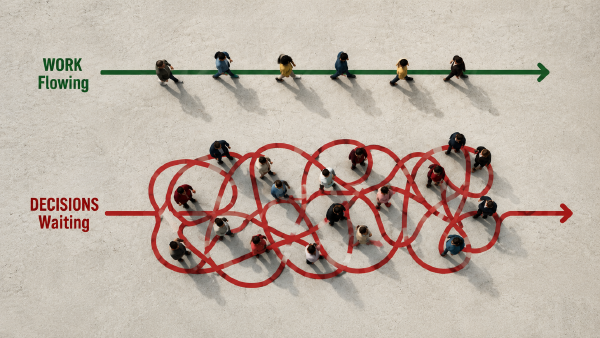
Customer attention is a downstream stage with limited capacity. Speed up everything upstream of it without limiting what goes in, and the pile of released, unadopted work grows and gets older - that’s just basic queueing. It also breaks one of the assumptions behind Little’s Law: arrivals no longer equal departures, and much of this work never leaves at all.
And that part hasn’t changed. In nearly every company I’ve worked at that doesn’t think like a product company, and even some that do, very few people measure adoption.
Measure the pile#
Throughput tells you how much your system finishes. Cycle time tells you how long it takes. Neither has ever told you whether the work was worth doing, which is a case I made at length in The Feature Factory Strikes Back.
The Product Venn suggests plotting throughput against your main outcome metric for the last 4 quarters. It’s a fair conversation starter, but lagging outcomes and a dozen other changes in the same period will show you whatever story you went in looking for.
A more useful question is closer to home. How many items have been released but not adopted, and how old are they? That’s ageing work in progress, and you can track it with the same discipline you already apply upstream. That multinational team couldn’t have answered it, because nothing they’d shipped was instrumented.
Experiments have to end#
If building is cheap, it’s also the cheapest way to test an idea. Prototypes, fake doors, a feature flag for a handful of users, a bet you can kill in a week. A team using AI well should be running more experiments than ever.
But experiments only work if some of them end.
Slop is what you get when you build a lot and never remove anything.
Kanban practitioners have long treated discard as a legitimate way for work to leave the system. In my experience, most product teams don’t have a discard state, don’t track how often they use one, and don’t celebrate it when they do.
When I talk to teams about value, I put it this way: a bet stopped early, on evidence, is value too. So ask how much of your portfolio you actually stop.
The Product Venn article doesn’t mention removing anything. One commenter on it put it better than I could: “Building got cheap, but removing things didn’t.” For me, that’s the missing half.
I do this too#
Like every other product person I know, I’ve got a side project or 5. Every month, when I set up the monthly page in my bullet journal, I move 6 to 9 projects forward from the previous month with a ‘>’.
AI makes starting cheap for me too. It does the breaking down and the planning, and the PRD sits in Obsidian. So the work carries on in my head, month after month, invisible in the everyday.
It’s the same pattern on a smaller board. Starting is cheap, and there’s no limit on how many I carry, and nothing ever reaches a point where it has to finish or go.
What to do instead#
Move your finished point. If done means adopted, your workflow needs states after release: released, found (someone reached it), used (someone tried it), adopted (they keep coming back), or discarded. You can’t do that without instrumenting what you ship.
Control work in progress after release as well as before it. Put a limit on how many released-but-unadopted items you’ll carry. When you hit it, stop starting and help something finish, which might mean marketing it, improving it or removing it.
Make discard a proper exit, and count it. A team that never discards anything isn’t learning.
Watch where the constraint moves. As AI speeds up building, expect work to age in review, testing, decisions and adoption. Your Work Item Age data will show you where long before an outcome chart does.
How many things did you release last quarter that no one has used yet? If you can’t answer that, it’s the first column to add to your board.